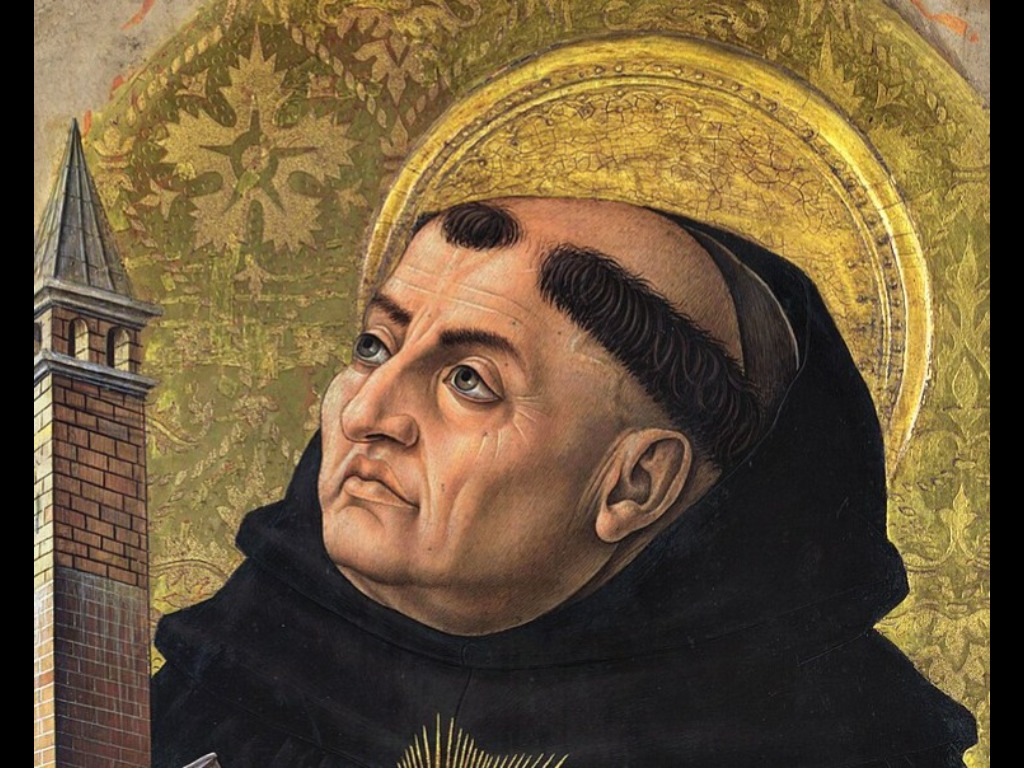
Time for Thomas
In our study of time, we compared
four leading theories: Presentism, Eternalism, Growing Block Theory, and
Branching Tree Theory. None of these theories are complete. None are cohesive.
To make progress, we extract a metaphysics of time from the work of Thomas
Aquinas, principally the Summa Theologica.[1]
The sections that follow demonstrate a comprehensive and cohesive theory that is far
superior to modern approaches.
Experiencing the Present. A Thomistic theory of time
provides a better solution than Presentism. Rather than grounding time in the
fleeting present of subjective human experience, Aquinas grounds time in God’s
unchanging eternity (ST I, 10.2; ST I, 10.1).[2] God does not experience
time through movement; God is wholly present. Past, present, and future are the
same (simultaneous) to him. For humans, the “now” of time moves, but for God,
this “now” stands still.[3] This treatment agrees with
Augustine.[4] Leftow says “whatever
exists necessarily is intrinsically timeless;” and “God exists necessarily.”[5]
Astrophysicist Hugh Ross[6] uses the analogy of
flatlanders to describe God’s transcendence of time. If life is confined to
planar surface, then God has the superior view from the third dimension,
engaging all time and (flat) space at once. Page[7] observes similarly that
Anselm’s view of eternity is like a super-temporal dimension that contains time
and temporal entities.
God timelessness is not static. He
is a living Being.[8]
Weinandy characterizes the Trinity as three persons fully giving themselves in
love to the other—perichoretic subsistent relations, fully in act.[9] God extends the gift of
life to his time-bound creation.
Contemplation. Aquinas further asserts that the contemplative life
helps us understand God’s eternal presentness. This shared “now,” provides the
means by which humans—soul-formed bodies (ST I, 75-76)—can know God. The
contemplative life lovingly gazes on God’s truth, goodness, and beauty.[10] Accordingly, the quietude
of contemplation experiences God’s presence (or ever present-ness). Temporal
concerns fade and the motion of time slows in our mind as we meditate on God
and his divine rest.
Succession. Aquinas recognizes the experience of time in
succession. This too helps us learn more about God. “As we attain to the
knowledge of simple things by way of compound things, so must we reach to the
knowledge of eternity by means of time, which is nothing but the numbering of
movement by ‘before’ and ‘after.’ For since succession occurs in every movement,
and one part comes after another, the fact that we reckon before and after in
movement, makes us apprehend time.” We experience time in two ways: “time
itself, which is successive; and the ‘now’ of time, which is imperfect.” “Time
is the numbering of movement (ST I, 10.1).”
According to Aquinas’s time is
grounded in God’s eternity. The creation of time provides the means for man to
know God, the end (goal) of all human endeavor.
Time’s Structure. Aquinas provides a comprehensive
description of time’s order. Time has a beginning, an ordered structure, and an
end. The experience of time enables humans to learn and grow.
Time’s beginning. Aquinas says: “Things are said to
be created in the beginning of time, not as if the beginning of time were a
measure of creation, but because together with time heaven and earth were
created (ST I, 46.3).” “That the
world began to exist is an object of faith, but not of demonstration or science
(ST I, 46.2).” There are two reasons for this. First, quoting Jerome,
Aquinas states "‘God is the only one who has no beginning.’ Now whatever
has a beginning, is not eternal. Therefore, God is the only one eternal (ST
I, 10.3).” Second, God creates the universe voluntarily, not of necessity (ST
I, 19.3). Therefore, reasoning from cause to effect may be inconclusive.
But, philosopher of science Stephen Meyer argues that key scientific findings
in the 20th century make a compelling case for a beginning to the
universe and therefore a cause behind this beginning.[11]
Time’s order. In his teleological argument Aquinas argues: “Now
whatever lacks intelligence cannot move towards an end, unless it be directed
by some being endowed with knowledge and intelligence…Therefore, some
intelligent being exists by whom all natural things are directed to their end. (ST
I, 2.3).” Meyer supports this observation by noting the extreme fine-tuning
of the universe. This includes the incomprehensible fine-tuning of the
universe’s initial conditions, to 1 part in 1010^123, and this
according to the Nobel-Prize-winning physicist Sir Roger Penrose.[12]
Time’s end. “Since the beginning of all things
is something outside the universe, namely, God…we must conclude that the end of
all things is some extrinsic good…The end of the whole universe must be a good
outside the universe (ST I, 103.2).” Aquinas understands this to mean
that humans have an eternal future participating in the divine life. "God
was made man, that man might be made God (Augustine quoted in ST III,
1.2).”[13]
Parker and Jeynes[14] (Parker, 2023) develop a
model that demonstrates that the 2nd Law of Thermodynamics is a fundamental (rather than
emergent) property of the universe. Using a complex (2D) time approach, in
which the real part of time is irreversible and the imaginary part of time is
reversible, they show that a system’s Hamiltonian and its entropy production
are Wick-rotated complex conjugates of each other. Time’s arrow is built into
the design of the universe.[15]
Time’s progression. In contrast with the B-series that only records
events, time’s progression has a purpose. For unlike God, who knows things
“altogether at once” (ST I, 14.7), human learning takes time.[16] This is movement (in
time) from ignorance to knowledge. Learning prepares us for the future.[17] Virtuous habits measure
this progress.[18]
This again matches Meyer. His third
argument for a theistic origin to the universe is life’s DNA code.[19] When bacteria divide,
they pass on their DNA to their progeny. Replication includes error checking.
Bacteria adapt to changes in the environment, and pass on what they learn to
the next generation. Learning is a design feature of the universe. Life is digital.
A-theory anchors time to the
present. This works for Aquinas because God is always present. The present is
indeed privileged. B-theory anchors time to physics. The spacetime universe had
a beginning. Time is part of the geometry of the universe. Aquinas takes this
further. Time has a beginning and an end. Time is structured so life can learn.
The book of life keeps a permanent record (Rev. 20:15).
Progress in Time. In the analogia entis (analogy
of being), Aquinas offers a better approach than the Growing Block Theory. The
universe is ordered to God’s end, and human learning has a goal—the beatific
vision. Man is made in God’s image. God shows himself through the incarnation,
and we learn by analogy. God shapes the world for man and God shapes man to
return to God. According to Thomas, and following Aristotle, man is neither
like God (univocally), nor unlike God (equivocally), but is apprehended in similarity
(analogically).[20]
God makes himself known to man through both nature and grace.[21] Analogy is another old
idea. Four hundred years before Moses, the Middle Bronze Age herdsman Job
sought an intermediary between himself and God (Job 9:33).
Guided by the writings of the
German-Polish Jesuit philosopher Erich Przywara (1889-1972), John Betz[22] (Betz, 2023) unfolds the
analogy of being, as part of his analogical metaphysics. For Betz (and
Przywara) analogy provides the means to connect human and divine. Beholding God
in the flesh provides our example (John 1:14). Through grace, God conforms us
to the image of his Son. Transformation occurs incrementally, in time,
which is the perfecting goal of analogy (1 John 3:2). Learning through analogy
and time progresses to the achievement of God’s good end, not only for
individuals but for the church through the ages.[23]
Aquinas gains important support
from science. There is an optimizing principle in biology. Organisms optimize
their performance in search of physical limits. Biophysicist William Bialek
(Bialek, 2012) documents optimal performance in the single photon counting in
eyes, echolocation in bats, fruit fly embryo development, and cellular
information processing (Tkačik, 2016). Living systems seek the best the
Lawgiver has for them. It follows (by analogy) that humans can also aim for
best performance, whether in mastering the violin, understanding the secrets of
the atom, or in becoming more like Christ.
The unfolding (ascent) of the
universe with time results in the formation of galaxies that host stars that
accrete planets that can host life. God causes life to grow until the planet is
ready for human life. The universe will eventually wind down (descent) but
before it does, God descends (condescends) into the universe in the incarnation
(ST III, 34.1). His resurrection (ascent) leads the way, and humans have
the opportunity to ascend to God. This single cycle of death and
resurrection repeats (in analogy) in the evening and morning of the Hebrew day
and the yearly cycle of seasons.[24] Time is cyclical.[25]
An expanding universe provide
capacity for complexity. God uses this capacity to originate life, visit
humanity, and accomplish his good ends. Aquinas not only describes the
opportunity for learning within time, but the goal of this learning, which is
the ideal of Christlikeness. We learn by analogy. In modern terms, time is an
interface.
Free Will in Time. Aquinas provides a clearer
understanding of time and its use by human agents than the Branching Time
Theory. First, allaying Prior, Aquinas acknowledges human free will (and moral
responsibility). However, the work of free agents is only good if it serves a
greater good.[26]
God willingly creates the world to achieve his good end. By his authority,
kings (and other subordinate authorities) exercise their free will to good
ends. However, man needs help in accomplishing God’s good works.
Aquinas gains support from science
and engineering. The Belief, Desire, and Intention (BDI) framework, with
heritage in the tensed logic of Prior, is an important artificial intelligence
(AI) tool for rational (intelligent) agents that mimic human reasoning and
decision-making.[27]
But in a nod to Aquinas, the robotic systems work to the particular ends of
their human designers. Autonomous agents serve proximate ends, but lack the
wisdom and foresight of their designers. Similarly, God’s good ends apply to
the right working of kingdoms and the ordering of families.
Significantly, God is in full
knowledge of possible worlds (counterfactuals). These he knows at once in the
simultaneity of his ever-presentness.[28] This aligns with Lewis
and fixed manifolds associated with possible worlds. This raises the question
of predestination. Aquinas acknowledges original sin (ST I-II, 82) and distinguishes
between operating and co-operating grace.[29] We need God working in
us for salvation (operating grace) and with us for godly living
(co-operating grace) (ST I-II, 111.2). Freewill actions submit to the
divine authority that moves heaven and earth and apply to the building of the
New Jerusalem. Augustine (Augustine, Exp. Ps. 122) argues that preaching
the gospel and caring for the poor add stones to the foundation of the City of
God.
In robotics and in human
experience, solutions to difficult problems benefit from outside expertise.
This does not obviate autonomous (algorithmic) decision making or human
(conscious) free will, but without receiving a helping hand, it may not be
possible to solve a specific problem or to “level up” to a new capability. By
analogy, man needs God’s grace. Grace provides the only opportunity for
soul-formed bodies to enter into the blessing God envisions. God made us so we
can know this freedom.
Summary of Thomistic Metaphysics of
Time. The table
contrasts the scholastic system with the weaker and incomplete modern
approaches. This is a coherent and comprehensive approach.

Thomas Aquinas provides a
philosophy of time grounded in God’s eternity. Time has two aspects: its
succession from before to after, and its presence, the “now” of time. God’s
creation of the universe marks the beginning of time. The universe is ordered
to its end, and time records this progress. Man (soul-formed body) can know God
both through nature and the incarnation. This knowledge is analogical. Knowing
God takes time. Learning progresses discursively, through contemplation, and in
the development of virtuous habits, corresponding to the movement in time from
ignorance to knowledge (succession), rest that comes from gazing on God’s love
(and his ever-presence), and practical experiences of virtuous living. Humans
are moral agents; their free actions can accomplish great good. Man needs God’s
help for salvation and for godly living. God knows all the possibilities at
once. The final end, and the corresponding end of time, is the beatification of
the saints in body and soul, experiencing delight in God’s presence, love, and
goodness.
There is room for further exploration of this theory. Additional study could seek to understand not only what time is (a single cycle of God’s complete action, and an interface for knowing God), but what time represents. Just as physical light represents the divine light of God’s glory (ST I, 12.5; Conf., xxxiii, 51-53), physical time may represent a divine vitality. God is unmoved by the time he creates, but he is also a living being. He is always acting (relating) in the present, in fulfillment of his wise plans.
Image: Public Domain.
[1] Thomas Aquinas, Summa
Theologica, trans. Fathers of the English Dominican Province (Grand Rapids,
MI: Christian Classics Ethereal Library, n.d.), https://www.ccel.org/ccel/a/aquinas/summa/cache/summa.pdf.
[2] “The idea of eternity follows
immutability, as the idea of time follows movement…Hence, as God is supremely
immutable, it supremely belongs to Him to be eternal. Nor is He eternal only;
but He is His own eternity; whereas, no other being is its own duration, as no
other is its own being (ST I, 10.2).” “Eternity is known from two
sources: first, because what is eternal is interminable—that is, has no
beginning nor end…secondly, because eternity has no succession, being
simultaneously whole (ST I, 10.1).”
[3] “We apprehend the flow of the ‘now,’
so the apprehension of eternity is caused in us by our apprehending the ‘now’
standing still (ST I, 10.2).”
[4] “It is not in time that you
precede times. Otherwise, you would not precede all times. In the sublimity of
an eternity which is always present, you are before all things past and
transcend all things future, because they are still to come, and when they have
come, they are past…Your ‘years’ neither go nor come. Ours come and go so that
all may come in succession…Your ‘years’ are one ‘day’ (Ps 90:4, 2 Pet 3:8), and
your ‘day’ is not any and every day but Today, because your Today does not
yield to a tomorrow, nor did it follow on a yesterday. Your Today is
eternity…You created all times and you exist before all times. Nor was there
any time when time did not exist (Confessions, XI, xii, 16).”
[5] Brian Leftow, Time and Eternity
(Ithaca, NY: Cornell University Press, 1991), 270.
[6] Hugh Ross, The Creator and the
Cosmos: How the Greatest Scientific Discoveries of the Century Reveal God, 3rd
expanded ed. (Colorado Springs: NavPress, 2001), 113.
[7] Ben Page, “Timelessness à la
Leftow,” TheoLogica: An International Journal for Philosophy of Religion and
Philosophical Theology 9, no. 1 (March 19, 2024), https://doi.org/10.14428/thl.v9i1.80543, accessed April 2, 2025.
[8] “What is truly eternal, is not
only being, but also living (ST I, 10.1).” “'Eternity is the
simultaneous and complete possession of infinite [limitless] life (Boethius,
1902, V, vi).”
[9] Thomas G. Weinandy, “The Immutable
and Impassible Trinity, Part 2,” in On Classic Trinitarianism, ed.
Matthew Barrett (Downers Grove, IL: IVP Academic, 2024), 359.
[10] “That
which belongs principally to the contemplative life is the contemplation of the
divine truth, because this contemplation is the end of the whole human life.
Hence Augustine says (De Trin. i, 8) that ‘the contemplation of God is
promised us as being the goal of all our actions and the everlasting perfection
of our joys.’ This contemplation will be perfect in the life to come, when we
shall see God face to face (ST II-II, 180.4).” “External bodily
movements are opposed to the quiet of contemplation, which consists in rest
from outward occupations: but the movements of intellectual operations belong
to the quiet of contemplation (ST II-II, 180.6).”
[11] Nobel prize
winner Arno Penzias, who with Robert Wilson detected the Cosmic Microwave
Background signal (the afterglow of the Big Bang) says “the best data we have
are exactly what I would have predicted, had I nothing to go on but the first
five books of Moses, the Psalms, the Bible as a whole (quoted in Meyer, 2021,
243).” The observations of science confirm what Aquinas could only reason to be
true.
[12] Another example
of fine tuning is the triple-alpha process that forms carbon in stellar
nucleosynthesis. This discovery caused astronomer Fred Hoyle to posit that a
super-intellect that had “monkeyed with physics (Meyer, 2021, 139, 148-151).”
[13] Man does not become God, but in the
future mankind participates in the divine nature (ST I-II, 112.1).
[14] M. C. Parker and C. Jeynes,
“Relating a System’s Hamiltonian to Its Entropy Production Using a Complex Time
Approach,” Entropy 25, no. 4 (2023): 629, https://doi.org/10.3390/e25040629.
[15] This work is
unconventional and not yet widely accepted; but it is worth following.
[16] “In our knowledge there is a
twofold discursion: one is according to succession only, as when we have
actually understood anything, we turn ourselves to understand something else;
while the other mode of discursion is according to causality, as when through
principles we arrive at the knowledge of conclusions (ST I, 14.7).” In
fact, God brings time to us, allowing us
to see light from galaxies billions of light years away—a grander disclosure
than the Psalmist knew (Ps 19:1-4)!
[17] “Memory of the
past is necessary in order to take good counsel for the future (ST II-II,
49.1).”
[18] “The rational powers, which are
proper to man, are not determinate to one particular action, but are inclined
indifferently to many: and they are determinate to acts by means of habits…Therefore
human virtues are habits (ST I-II, 55.1).” “The act of virtue is nothing
else than the good use of free-will (ST I-II, 55.1).”
[19] Each of the trillion cells in an
adult human body has approximately 3 billion base pairs of DNA. The nucleotide
bases form a 4-bit code. Even the simplest single-cell organisms (bacteria)
have this code (Meyer, 2021, Ch. 9-10).
[20] “For in analogies the idea is not,
as it is in univocals, one and the same, yet it is not totally diverse as in
equivocals; but…signifies various proportions to some one thing (ST I, 13.5).”
[21] “It would seem
most fitting that by visible things the invisible things of God should be made
known; for to this end was the whole world made, as is clear from the word of
the Apostle (Rom. 1:20): "For the invisible things of God…are clearly
seen, being understood by the things that are made." But, as Damascene
says (De Fide Orth. iii, 1), by the mystery of the Incarnation are made
known at once the goodness, the wisdom, the justice, and the power or might of
God (ST III, 1.1).” “By taking flesh, God did not lessen His majesty;
and in consequence did not lessen the reason for reverencing Him, which is
increased by the increase of knowledge of Him. But, on the contrary, inasmuch
as He wished to draw nigh to us by taking flesh, He greatly drew us to know Him
(ST III, 1.2).”
[22] John R. Betz, Christ the Logos
of Creation: An Essay in Analogical Metaphysics (Steubenville, OH: Emmaus
Academic, 2023).
[23] “Now the final perfection, which is
the end of the whole universe, is the perfect beatitude of the Saints at the
consummation of the world (ST I, 73.1).”
[24] These repeating patterns are
imprinted in Biblical revelation. The Jewish new year begins with death.
Passover (15th of Nisan) is when the seed dies (John 12:24). First
fruits are in spring. The nation climbs to Jerusalem in songs of ascents to
celebrate the feasts. Tabernacles follows the harvest (and judgment). Death and
resurrection are symbolized in baptism (Col 2:12) and communion, “proclaim[ing]
the Lord’s death until he comes” (our resurrection) (I Cor 11:26). Augustine
experiences this cycle in his ascent into God’s presence in prayer and his
descent to deliver the words he received (De doctrina christiana, IV,
xv, 32). The long ascent of the church on its pilgrimage through the age is
part of this picture.
[25] Scripture embeds this cyclicity in
the mirror structure of chiasma (ABB’A’). For example, Psalm 90, where Moses
compares God’s timeless transcendence with man’s evanescence, has a chiastic
structure.
[26] “Man has free-will: otherwise,
counsels, exhortations, commands, prohibitions, rewards, and punishments would
be in vain (ST I, 83.1).” “Wherever we have order among a number of
active powers, that power which regards the universal end moves the powers
which regard particular ends…The king [] who aims at the common good of the
whole kingdom, by his rule moves all the governors of cities, each of whom
rules over his own particular city…The will as agent moves all the powers of
the soul to their respective acts (ST I, 82.4).”
[27] In this framework, beliefs are
propositions about the current state of the world. Beliefs are drawn from
memory (past) and are constantly updated. Desires are propositions about
the future state of affairs the agent prefers. Intention commits the agent
to actions achieving these goals. Rao and Georgeff (Rao, 1998) formalize this
procedure using modal logic. Saul Kripke’s possible-world semantics assists the
authors in assessing belief-accessible (known), desire-accessible (sought), and
intent-accessible worlds (planned).
[28] “God knows all things; not only
things actual but also things possible to Him and creature; and since some of
these are future contingent to us, it follows that God knows future contingent
things…Contingent things are infallibly known by God, inasmuch as they are
subject to the divine sight in their presentiality; yet they are future
contingent things in relation to their own causes (ST I, 14.13).”
[29] “‘Man's way’ is said ‘not to be
his,’ in the execution of his choice, wherein he may be impeded, whether he
will or not. The choice itself, however, is in us, but presupposes the help of
God (ST I, 83.1).”
